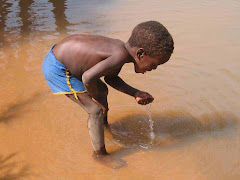
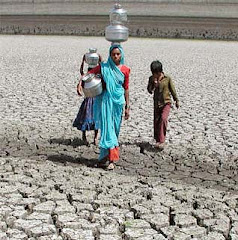
Water scarcity is giving rise to conflicts. Among people, within nations and between nations. At places, these conflicts are leading to growing instability among people. As is evident in the Middle East.
But, a leading expert in water resource policy and conflict resolution says though conflicts over water are at the heart of regional instability, they could become catalyst for cooperation and peace, if managed properly.
There is a growing tendency to cooperate over water even though politicians have threatened to take to the battlefield over the precious resource, he added. "Two thirds of the time we do anything over shared water, we cooperate. That is hugely important," said Programme Director in Water Conflict Management and Transformation at Oregon State University, Aaron Wolfe.
He feels that water turfs just lead to mere posturing by politicians of all hues. The last formal war over water was fought in 2,500 B.C. between two Sumerian city-states contesting the Tigris basin, he said recently at the United Nations General Assembly.
The problem, he says, is that water is often managed unilaterally and thus inefficiently, and is used to exacerbate tensions. Water itself did not respect political boundaries, but governments used man-made borders to protect their sovereignty, economies and nationalities.
Also, policy discussions over water issues focused too much on global trends and solutions, while neglecting the regional and sub-regional water disputes that were a real security concern, responsible for poverty, disease and degradation in many parts of the world.
His comments come as a whiff of fresh air after reports and comments, including the United Nations, warning that water stress, amplified by climate change, was likely to pose a mounting security challenge in the years to come.
The struggle for water could threaten fragile states and drive regional rivalry, the UN had warned in the third edition of World Water Development Report, entitled 'Water in a changing world', which was released during the World Water Forum at Istanbul in March 2009.
More than 1 billion people lack access to safe drinking water and 2.4 billion, or about half the world’s population, has no access to basic sanitation.
Every year, water-related ailments make some 250 million people sick and claim the lives of 2.2-5 million more. These statistics provide a powder keg good enough to explode and divide a humanity already divided. But, would the misery and pain by chance bring us together?
Wednesday, November 25, 2009

Friday, November 20, 2009
India's Jain Irrigation undertakes 'water footprint' project
Jain Irrigation, India's leading manufacturer of water distribution devices and irrigation systems, has charted plans to launch a water footprint initiative aimed at conserving the resource. It has roped in World Bank's private lending arm, International Finance Corporation (IFC) for the endeavour.
The initiative will allow Jain Irrigation to measure its environmental and sustainability benefits and help identify ways for it to reduce water consumption. This is one of the first such moves undertaken in the Indian corporate sector to understand the concept of water footprint.
Water footprinting involves evaluating direct and indirect water usage in business activities, including those of suppliers. It also entails understanding linkages to local water sources and scarcity, and assessing impacts on community water resources and the environment with the goal of adopting conservation measures.
The effort couldn't have come in at a better time. Water supply in the country is waning and pollution is eating into it further. In a country, where agriculture remains the mainstay of rural income, though as a percentage of gross domestic product (GDP) it remains less than one-fourth of a contributor, water availability plays an important role.
The project will demonstrate effective management of natural resources, particularly the benefits to farmers of water conservation. Jain Irrigation is a diversified player in the Indian water infrastructure industry and commands a sizeable presence in agri-business too.
The company claims to be the world’s second-largest drip irrigation systems company after Israel’s Terafin. Its micro-irrigation products are well entrenched in the Indian agriculture industry.
The water footprinting exercise is also expected to bring benefit to several other Indian companies. The project will also aim to develop tools that can be replicated by other private sector companies in ascertaining their direct and their suppliers' water exposure, minimizing water risks, improving water efficiencies, and limiting their water-related social and environmental impacts.
It would be a worthwhile effort for Indian companies, particularly in the water-intensive industries, to tune in and stay abreast with the initiative, and its results. In the near future, it would be prudent for these companies, as also others in India, to undertake water footprinting to not only bring down the usage of the scarce resources, but also understand the future business risk.
The initiative will allow Jain Irrigation to measure its environmental and sustainability benefits and help identify ways for it to reduce water consumption. This is one of the first such moves undertaken in the Indian corporate sector to understand the concept of water footprint.
Water footprinting involves evaluating direct and indirect water usage in business activities, including those of suppliers. It also entails understanding linkages to local water sources and scarcity, and assessing impacts on community water resources and the environment with the goal of adopting conservation measures.
The effort couldn't have come in at a better time. Water supply in the country is waning and pollution is eating into it further. In a country, where agriculture remains the mainstay of rural income, though as a percentage of gross domestic product (GDP) it remains less than one-fourth of a contributor, water availability plays an important role.
The project will demonstrate effective management of natural resources, particularly the benefits to farmers of water conservation. Jain Irrigation is a diversified player in the Indian water infrastructure industry and commands a sizeable presence in agri-business too.
The company claims to be the world’s second-largest drip irrigation systems company after Israel’s Terafin. Its micro-irrigation products are well entrenched in the Indian agriculture industry.
The water footprinting exercise is also expected to bring benefit to several other Indian companies. The project will also aim to develop tools that can be replicated by other private sector companies in ascertaining their direct and their suppliers' water exposure, minimizing water risks, improving water efficiencies, and limiting their water-related social and environmental impacts.
It would be a worthwhile effort for Indian companies, particularly in the water-intensive industries, to tune in and stay abreast with the initiative, and its results. In the near future, it would be prudent for these companies, as also others in India, to undertake water footprinting to not only bring down the usage of the scarce resources, but also understand the future business risk.
Subscribe to:
Posts (Atom)

.jpg)