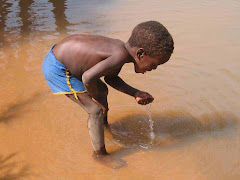
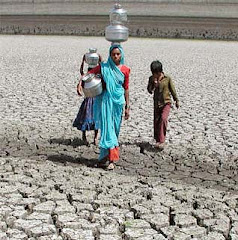
One in five of the world's companies using the largest amounts of water have said they are facing business constraints due to droughts and other shortages, flooding and rising prices, a global survey has revealed.
The survey of the 302 biggest companies in the most water-intensive sectors, across 25 countries revealed that water security remains high on the corporate agenda, with 67 per cent of respondents reporting responsibility for water-related issues at the board or executive committee level.
The inaugural Water Disclosure Report released by Carbon Disclosure Project (CDP) last week has said that encouragingly, 89 per cent of companies have already developed strategies surrounding the issue and 60 per cent have set targets relating to reducing water waste.
The findings of the global survey underline the fact that companies are increasingly viewing water as more than a potential business risk, with several proactive ones making efforts to be sustainable on this front.
The report also indicated that some of the world's largest and most water-intensive companies also see business opportunities in strengthening their water management practices and offering services to address water woes.
The survey is one of the many that the highly influential CDP carries out. The organization conducts an annual study of what companies are doing to measure and reduce greenhouse gas emissions on behalf of institutional investors holding $16trillion USD of assets.
The water survey was requested on behalf of these 137 institutional investors to increase transparency and accountability on water scarcity and other water-related issues, and help drive sustainability.
The water survey had asked the world's largest companies for information on their water use. It found that water is already impacting business operations, with more than half of respondents classifying their water risk as current or imminent within one to five years.
News reports quoted head of CDP Water Disclosure Marcus Norton as saying, "We see corporations using their imagination and looking at these challenges as opportunities for growth. From some of the feedback from companies, I think it's really a reflection that companies have been through this with carbon."
"This is a strategic issue. Water is fairly cheap, often undervalued and underappreciated. Companies I'm sure will save some costs by measuring and managing their water use, but by properly understanding the watershed they operate in, and their suppliers operate in, they will put themselves in a position to understand and mitigate risk, and to understand and seize opportunities. How I think water will really hurt companies is not that it becomes more expensive, but that it runs out or they don't have access to it". he added.
The report said companies in the food and drink, tobacco, and metals and mining sectors were most at risk. Among the concerns listed by them were fines and litigation for pollution.
Companies in the chemical and pharmaceuticals & biotech sectors had high response rates, at 100 per cent and 81 per cent while those in the oil & gas and construction, infrastructure & real estate industries lagged behind. Overall, about 80 per cent of companies opted to report their results publicly, the report added.
Monday, November 29, 2010

Friday, April 23, 2010
World's top 302 companies asked to disclose water usage
Several of the world's largest corporations, some with operations spanning several countries, have been urged to disclose their complete water usage and participate in the first voluntary water-disclosure exercise being undertaken at a global scale by London-based investor-backed non-profit organization Carbon Disclosure Project (CDP).
The CDP issued the first of its kind water-disclosure questionnaire last week in London and began a campaign that seeks to put water consumption on par with carbon emissions as a concern of company shareholders. The organization had scheduled for release of the questionnaire around this time when it launched the initiaitve around November last year.
The exercise is purely voluntary and those who have been approached may not respond. But, they are being encouraged by a pool of investors that brings with it formidable wealth, to do so. The investors represent some $16000 billion worth of assets between themselves.
The initiative comes against a backdrop of declining global water availability creating an immense challenge for companies, and a demand for increasing accountability on usage of the fast depleting resource. In fact, several reports have highlighted that poor water availability as well as an increase in its procurement cost is emerging a formidable business risk.
Several projections point out that in several areas across the world, water may not just be available to run business operations in the not so distant future. At the same time, experts have been issuing stern warnings that companies, and their investors, should start to appreciate the new category of risk to their future businesses -- running out of water.
Projects like CDP's not only manage to create awareness and help businesses and institutional investors understand the risks and opportunities associated with water scarcity and other water-related issues, but at the same time, give a unstated warning to most companies operating in water-intensive sectors.
The 302 companies asked to send in their responses by July-end include the who's who of the global business world -- ABB, Nokia, Intel, Procter & Gamble, Bayer, Boeing, Cadbury, Carrefour, Christian Dior, Danone, IBM, Johnson & Johnson, Coca-Cola, Nestle, Unilever, PepsiCo, McDonald's, Nike, Novartis, Sony Corporation, Yum Brands, among others.
Ford, PepsiCo, Molson Coors, L’Oréal and Reed Elsevier, some of whom are involved in the project in various capacities, are among those who have already accepted to respond.
Indian companies that have been sent the questionnaire are Bharat Heavy Electricals LTD (BHEL), Indian Oil, ITC, Larsen & Toubro, NTPC, ONGC, Reliance Industries, Steel Authority of India Ltd (SAIL). There is also Arcelor Mittal, the global steel giant of India-born LN Mittal.
The questionnaire asks the respondents to spell out if they have a water policy, strategy or management plan. And, if they have one, then it asks comanies to describe it.
It also asks respondents to identify the percentage of their operations in the world’s water-stressed areas and what portion of their water use comes from these regions. It asks companies to spell out their water use, recycling and discharges into or near wildlife habitats as well as list water-related risks and opportunities.
Basically, companies are being asked for details of their water footprint and also make a disclosure that they are maintaining stewardship on this count.
Companies that choose to respond to the questions have the option of making their answers available only to these investors, or to the larger public as well. Also, companies that have not been sent the questionnaire can also respond to it, if they want.
As human population growth and climate change exacerbate water shortages worldwide, such efforts will go a long way to ensure that water management remains tight, and companies and people remain accountable for their water usage.
The CDP issued the first of its kind water-disclosure questionnaire last week in London and began a campaign that seeks to put water consumption on par with carbon emissions as a concern of company shareholders. The organization had scheduled for release of the questionnaire around this time when it launched the initiaitve around November last year.
The exercise is purely voluntary and those who have been approached may not respond. But, they are being encouraged by a pool of investors that brings with it formidable wealth, to do so. The investors represent some $16000 billion worth of assets between themselves.
The initiative comes against a backdrop of declining global water availability creating an immense challenge for companies, and a demand for increasing accountability on usage of the fast depleting resource. In fact, several reports have highlighted that poor water availability as well as an increase in its procurement cost is emerging a formidable business risk.
Several projections point out that in several areas across the world, water may not just be available to run business operations in the not so distant future. At the same time, experts have been issuing stern warnings that companies, and their investors, should start to appreciate the new category of risk to their future businesses -- running out of water.
Projects like CDP's not only manage to create awareness and help businesses and institutional investors understand the risks and opportunities associated with water scarcity and other water-related issues, but at the same time, give a unstated warning to most companies operating in water-intensive sectors.
The 302 companies asked to send in their responses by July-end include the who's who of the global business world -- ABB, Nokia, Intel, Procter & Gamble, Bayer, Boeing, Cadbury, Carrefour, Christian Dior, Danone, IBM, Johnson & Johnson, Coca-Cola, Nestle, Unilever, PepsiCo, McDonald's, Nike, Novartis, Sony Corporation, Yum Brands, among others.
Ford, PepsiCo, Molson Coors, L’Oréal and Reed Elsevier, some of whom are involved in the project in various capacities, are among those who have already accepted to respond.
Indian companies that have been sent the questionnaire are Bharat Heavy Electricals LTD (BHEL), Indian Oil, ITC, Larsen & Toubro, NTPC, ONGC, Reliance Industries, Steel Authority of India Ltd (SAIL). There is also Arcelor Mittal, the global steel giant of India-born LN Mittal.
The questionnaire asks the respondents to spell out if they have a water policy, strategy or management plan. And, if they have one, then it asks comanies to describe it.
It also asks respondents to identify the percentage of their operations in the world’s water-stressed areas and what portion of their water use comes from these regions. It asks companies to spell out their water use, recycling and discharges into or near wildlife habitats as well as list water-related risks and opportunities.
Basically, companies are being asked for details of their water footprint and also make a disclosure that they are maintaining stewardship on this count.
Companies that choose to respond to the questions have the option of making their answers available only to these investors, or to the larger public as well. Also, companies that have not been sent the questionnaire can also respond to it, if they want.
As human population growth and climate change exacerbate water shortages worldwide, such efforts will go a long way to ensure that water management remains tight, and companies and people remain accountable for their water usage.
Subscribe to:
Posts (Atom)

.jpg)