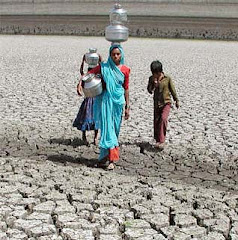
After years of struggle to solve its water woes on its own, Delhi seems to be gearing up to embrace the private sector.
The Delhi government has indicated that it is considering joint ventures with various private companies for treatment and distribution of water. The government had a few years ago handed over distribution of power in private hands, an exercise that has met with reasonable success.
Recently, Delhi Chief Minister Sheila Dikshit also hinted at overhauling the water distribution system on the lines of electricity distribution that the city government carried out in 2002.
The city's water utility Delhi Jal Board is looking at allocating treatment and distribution to at least four or five separate units that will take care of command areas under Wazirabad, Chandrawal, Sonia Vihar, Nangloi, Haiderpur and Bhagirathi treatment plants.
DJB, which also looks after water distribution, has been hauled up in recent months over complaints ranging from water contamination to erratic supply. The civic agency had last year outsourced the jobs of water billing and installation of water meters to private entities in an efforts to make the services more efficient.
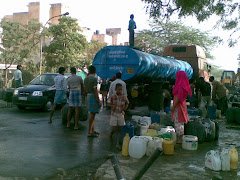
Delhi is slowly moving towards roping in the private sector in almost all aspects of water supply. Earlier this year, DJB given a long-term contract to SPML, one of India's leading companies in the water sector, for distribution of water to some areas in the city through private water tankers.
For years now, the city has been reeling under water shortage. DJB is only able to supply 800 million gallon per day (MGD) water as against the average demand of potable water of around 1,100 MGD.
Though Dikshit said reforms on the city’s water distribution system can only be brought after a consensus is reached on the issue, there has been apprehension in certain quarters regarding privatization of water. After water billing was handed over to private players, there had been several complaints about inflated water bills.
The naysayers seem to be holding on to that one example. They should realise that roping in the private sector to bring in efficienies and management expertise in certain areas does not mean privatisation.
For now, the CM has allayed fears that water management would not be privatized. Instead the government would enter into JVs with private companies or form smaller units under the government.
It is a matter of time before it becomes clear if the well-meaning Dikshit has taken yet another positive step!
Friday, March 25, 2011

Tuesday, March 15, 2011
Committee says India needs Rs 800,000 crore to provide water, waste management services
A committee set up by Indian Prime Minister Manmohan Singh has said the country would require investments to the tune of Rs 8,00,000 crore over the next 20 years to provide basic infrastructure services like water, wastewater and solid waste management.
To those who think the investment as huge, it would come as a surprise that this amount is about 20 per cent of the overall Rs 39.2 lakh crore (trillion) that the committee has said would be required to improve all basic urban infrastructure services during the next two decades.
Along with the investment, the government would need to undertake "major administrative reforms" to cope with the current rate of urbanization, said the high-powered expert committee (HPEC) on urban infrastructure led by one of India's leading economists Isher Judge Ahluwalia.
The body was formed by the Prime Minister in 2008 to estimate investment requirement for urban infrastructure services in the country. The committee submitted its report to Union Urban Development Minister Kamal Nath on March 7.
The committee recommended a regulatory regime for urban services at state levels to address challenges of not only pricing services correctly but also ensuring delivery of services and protection of the environment besides encouraging public private participation in service delivery.
In India, just about 64 per cent of urban population in India is covered by individual water connections compared with 91 per cent in China, 86 per cent in South Africa and 80 per cent in Brazil.
India's urban population is expected to increase from existing 350 million to 600 million by 2031. This population increase is expected to further put pressure in the country's dwindling water resources and the per capita water availability is expected to come down further from about 1730 cubic metre now to about 1240 by 2030.
The rapid growth of urbanization has compounded the problem of water scarcity in several Indian cities, where current demand is much higher than the supply. This has prompted several state governments to undertake water projects that seek to enhance supply for the growing population.
Indian companies in the water industry and even those with exposure to it should find this huge investment requirement an opportunity. The Government alone cannot come up with such huge amounts on its own.
This should clear the way for further participation from the private sector in the water industry, fast eing considered a sunrise industry by many. Public-private partnerships (PPP) should become the order of the day.
To those who think the investment as huge, it would come as a surprise that this amount is about 20 per cent of the overall Rs 39.2 lakh crore (trillion) that the committee has said would be required to improve all basic urban infrastructure services during the next two decades.
Along with the investment, the government would need to undertake "major administrative reforms" to cope with the current rate of urbanization, said the high-powered expert committee (HPEC) on urban infrastructure led by one of India's leading economists Isher Judge Ahluwalia.
The body was formed by the Prime Minister in 2008 to estimate investment requirement for urban infrastructure services in the country. The committee submitted its report to Union Urban Development Minister Kamal Nath on March 7.
The committee recommended a regulatory regime for urban services at state levels to address challenges of not only pricing services correctly but also ensuring delivery of services and protection of the environment besides encouraging public private participation in service delivery.
In India, just about 64 per cent of urban population in India is covered by individual water connections compared with 91 per cent in China, 86 per cent in South Africa and 80 per cent in Brazil.
India's urban population is expected to increase from existing 350 million to 600 million by 2031. This population increase is expected to further put pressure in the country's dwindling water resources and the per capita water availability is expected to come down further from about 1730 cubic metre now to about 1240 by 2030.
The rapid growth of urbanization has compounded the problem of water scarcity in several Indian cities, where current demand is much higher than the supply. This has prompted several state governments to undertake water projects that seek to enhance supply for the growing population.
Indian companies in the water industry and even those with exposure to it should find this huge investment requirement an opportunity. The Government alone cannot come up with such huge amounts on its own.
This should clear the way for further participation from the private sector in the water industry, fast eing considered a sunrise industry by many. Public-private partnerships (PPP) should become the order of the day.
Subscribe to:
Posts (Atom)

.jpg)