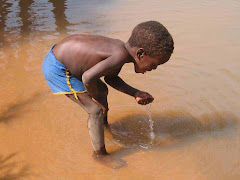
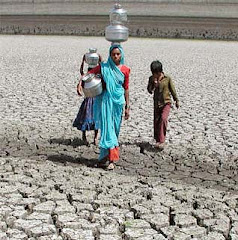
Cola major PepsiCo has unveiled global plans to provide access to safe water to three million people in developing countries by 2015. The company has also announced plans to bring down its water consumption in production.
PepsiCo announced recently that it would continue to make efforts to arrive at positive water balance in its operations in water-distressed areas.
It will be a welcome step as the company, along with its main rival Coca Cola, has often been accused of exploitation of water resources around some of its manufacturing plants. The two cola majors have been under intense pressure in India, where they have both been separately announcing plans to arrive at a positive water balance -- recharging water levels in areas where their plants have become controversial as much as they have been taking from the soil.
The company said during 2011, the PepsiCo Foundation will reach its goal of providing access to safe water and sanitation to 1 million people through support of several partners. It has been working with several partners, spread across countries, in projects that seek to enhance access to water and sanitation facilities to local communities.
A statement issued by the company said it had set a global goal in 2007 to reduce water consumption by 20 per cent per unit of production by 2015. To date, the company has achieved a more than 15 per cent improvement in water use efficiency as compared to the company's 2006 baseline, it added.
Some of its global partners include Water.org, Safe Water Network, The Energy Resources Institute, China Women's Development Foundation and the Earth Institute at Columbia University. Together, they have been helping install village water and irrigation systems, establishing water health centers, constructing rainwater harvesting cisterns, improve sanitation programs and recharge aquifers in developing communities, particularly in Ghana, Kenya, Brazil, China and India.
The announcements by the company come against a backdrop of increased focus of corporate role in sustainable development. Companies are now being held accountable for mismanagement of water resources, particularly in water-starved regions.
Showing posts with label water-stressed. Show all posts
Showing posts with label water-stressed. Show all posts
Monday, April 5, 2010

Monday, March 15, 2010
World's leading companies not forthcoming on water-related risk disclosures: Report
Most companies operating in water-intensive sectors including utilities and computer-chip makers are failing to provide investors with enough information on water-related risks, a report has warned.
Also, investors have almost no idea how their supply chains could be hit by water shortages in the future in several cases, the report -- 'Murky Waters: Corporate Reporting on Water Risk' -- prepared by sustainable investor group CERES and financial services firm UBS, states.
Even though most of these publicly-traded companies depend on water, they do not adequately disclose their financial risks to droughts and future regulations, even as water scarcity problems mount across the world.
The report, released last month, assessed the water-related disclosures of 100 of the world's largest publicly traded companies operating in the food, drink, electricity, mining, oil and gas, semiconductor, chemicals and construction industries.
It scored the companies based on five key categories of disclosure: water accounting, risk assessment, direct operations, supply chain and stakeholder engagement.
Puting the companies' water policies on a scale of up to 100, the report found that even the best-performing firms like beverage giant Diageo, Swiss mining company Xstrata and US electricity provider Pinnacle West, scored not more than 43 points. Eighty of the 100 companies scored fewer than 30 points.
Overall, several companies did not include any information on water risks and performance in their financial filings and provided no data on how water shortages could affect facilities operating in water-stressed regions.
Non-availability of water has emerged as a formidable business risk across the world. Poor water availability as well as an increase in its procurement cost are predicted with increasing frequency and climate change and poor management of water resources are expected to exacerbate the problem of scarcity.
CERES, which is a Boston-based coalition of investors with $8 trillion USD under management, used information collected by Bloomberg LP from corporate reports and financial filings of beverage, chemicals, electric power, food, homebuilding, mining, oil and gas and semiconductor companies. UBS analyzed the data for CERES. Regulatory, reputational and litigation risks related to water supply were also looked into.
The report states that not even one company from the 100 selected had provided detailed water data on its supply chains, despite the fact that many of them operate global supply chains with sizeable water footprints across several areas of the world that are at high risk from the increased incidence of droughts.
It cites some recent incidents where businesses have been affected by regional water shortages. For instance, the drought in California last year reportedly cost the state's agricultural industry $1 billion USD (£640 million) and led to the loss of an estimated 21,000 jobs. Similarly, the 2007-08 drought in Georgia increased costs for energy firm Southern Co by $33 million as it was forced to replace falling hydroelectric power output with more costly fossil fuel-based power.
Also, investors have almost no idea how their supply chains could be hit by water shortages in the future in several cases, the report -- 'Murky Waters: Corporate Reporting on Water Risk' -- prepared by sustainable investor group CERES and financial services firm UBS, states.
Even though most of these publicly-traded companies depend on water, they do not adequately disclose their financial risks to droughts and future regulations, even as water scarcity problems mount across the world.
The report, released last month, assessed the water-related disclosures of 100 of the world's largest publicly traded companies operating in the food, drink, electricity, mining, oil and gas, semiconductor, chemicals and construction industries.
It scored the companies based on five key categories of disclosure: water accounting, risk assessment, direct operations, supply chain and stakeholder engagement.
Puting the companies' water policies on a scale of up to 100, the report found that even the best-performing firms like beverage giant Diageo, Swiss mining company Xstrata and US electricity provider Pinnacle West, scored not more than 43 points. Eighty of the 100 companies scored fewer than 30 points.
Overall, several companies did not include any information on water risks and performance in their financial filings and provided no data on how water shortages could affect facilities operating in water-stressed regions.
Non-availability of water has emerged as a formidable business risk across the world. Poor water availability as well as an increase in its procurement cost are predicted with increasing frequency and climate change and poor management of water resources are expected to exacerbate the problem of scarcity.
CERES, which is a Boston-based coalition of investors with $8 trillion USD under management, used information collected by Bloomberg LP from corporate reports and financial filings of beverage, chemicals, electric power, food, homebuilding, mining, oil and gas and semiconductor companies. UBS analyzed the data for CERES. Regulatory, reputational and litigation risks related to water supply were also looked into.
The report states that not even one company from the 100 selected had provided detailed water data on its supply chains, despite the fact that many of them operate global supply chains with sizeable water footprints across several areas of the world that are at high risk from the increased incidence of droughts.
It cites some recent incidents where businesses have been affected by regional water shortages. For instance, the drought in California last year reportedly cost the state's agricultural industry $1 billion USD (£640 million) and led to the loss of an estimated 21,000 jobs. Similarly, the 2007-08 drought in Georgia increased costs for energy firm Southern Co by $33 million as it was forced to replace falling hydroelectric power output with more costly fossil fuel-based power.
Subscribe to:
Posts (Atom)

.jpg)